Why Businesses Need an Annual Maintenance Contract
Every business depends on equipment, systems, and facilities to keep daily operations running smoothly. Whether it is an office building, retail store, warehouse, hotel, factory, or commercial property, regular maintenance is essential for keeping these assets in good working condition.
Unexpected equipment failures can interrupt operations and create unnecessary expenses. When a critical system stops working, businesses may need emergency repairs, replacement components, or even temporary solutions to continue operating.
An Annual Maintenance Contract (AMC) offers a more organized approach to these challenges. Instead of waiting for equipment to fail, businesses can arrange regular inspections, servicing, and maintenance through a professional service provider.
A well-planned AMC can improve reliability, simplify maintenance management, and provide businesses with greater control over their maintenance expenses.
What Is an Annual Maintenance Contract?
An annual maintenance contract is a service agreement between a business and a maintenance company for a defined period, generally twelve months. The agreement specifies the equipment or systems covered, maintenance schedule, services provided, response times, and applicable costs.
Depending on the contract, services may include preventive maintenance, routine inspections, troubleshooting, minor repairs, emergency support, and technical assistance.


The exact scope varies between providers. Some contracts may cover labor and regular servicing, while spare parts and major repairs may be charged separately. Businesses should therefore review the agreement carefully before making a commitment.
Reduced Risk of Unexpected Breakdowns
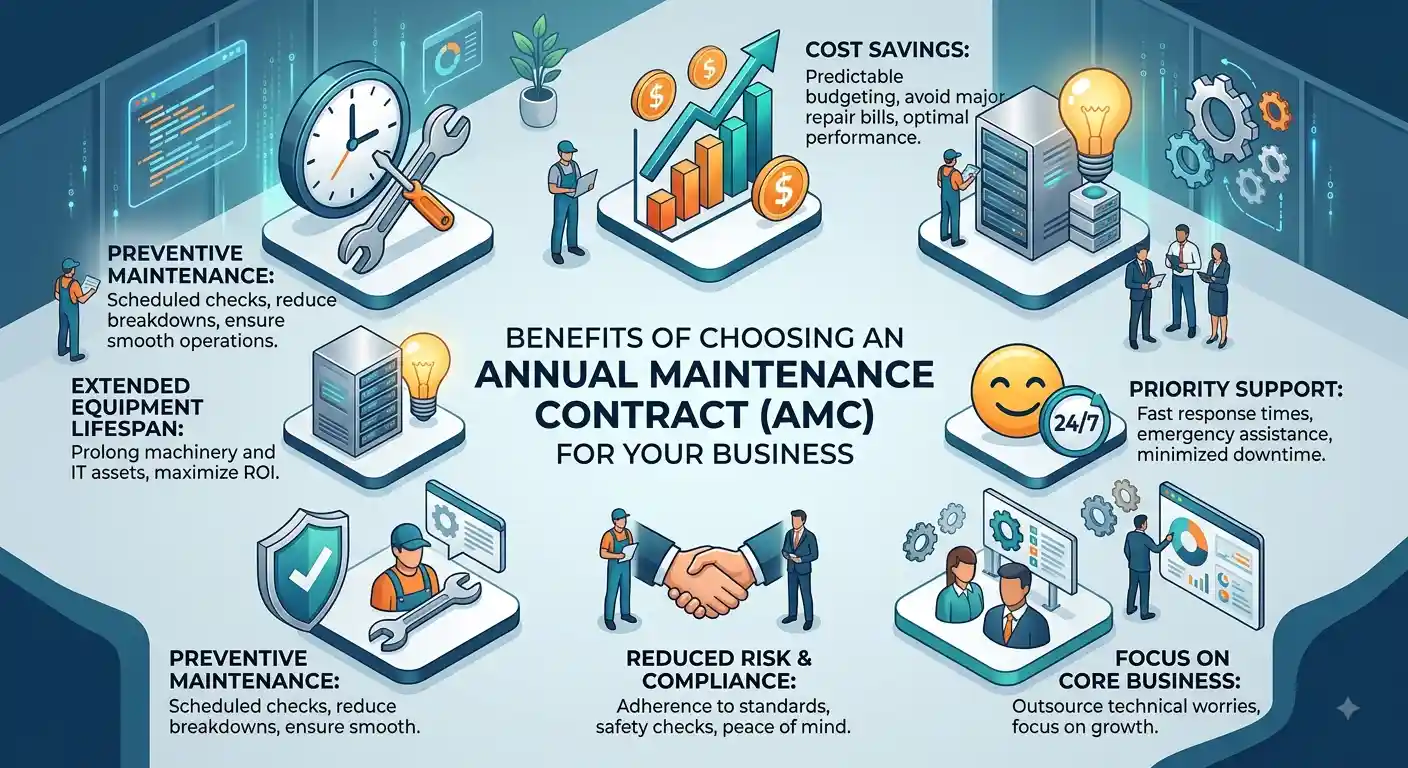
One of the biggest benefits of an AMC is that it focuses on preventive maintenance. Instead of waiting until a system completely fails, technicians regularly inspect equipment to identify signs of wear, damage, or declining performance.
Early detection can make it possible to address relatively small problems before they develop into major breakdowns.
For a business, avoiding unexpected downtime can be extremely important. A malfunctioning air conditioning system, electrical installation, generator, plumbing system, or other essential facility can affect employees and customers while disrupting normal operations.
Regular maintenance helps businesses take a proactive approach rather than constantly reacting to emergencies.
Better Control Over Maintenance Costs
Unexpected repairs can make maintenance expenses difficult to predict. Emergency service calls may also cost more than scheduled maintenance because they often require immediate attention.
An annual maintenance contract can provide greater financial predictability. Businesses know in advance what they are paying for the agreed maintenance services and can plan their budgets accordingly.
While an AMC does not necessarily eliminate all repair expenses, it can help reduce avoidable costs by identifying problems earlier and encouraging regular servicing.
Improved Equipment Efficiency
Equipment that is poorly maintained may gradually lose efficiency. Dirt, worn components, incorrect settings, blocked filters, electrical issues, and other problems can affect performance.
Regular servicing allows technicians to inspect equipment and address issues that may be affecting its operation.
Maintaining equipment in good condition can support consistent performance and help businesses avoid unnecessary interruptions. It can also contribute to more efficient use of resources, depending on the type of equipment being maintained.
Extended Equipment Lifespan
Commercial equipment is a significant investment for many businesses. Replacing equipment earlier than expected can put additional pressure on the company’s budget.
Regular maintenance helps protect this investment. Technicians can identify worn components, perform necessary servicing, and recommend repairs before equipment suffers serious damage.
An annual maintenance contract can therefore support the long-term usability of equipment and reduce the likelihood of premature replacement.
Faster Access to Professional Support
When a business does not have an established maintenance provider, finding a qualified technician during an emergency can take time.
An AMC creates an ongoing relationship between the business and maintenance company. When a maintenance issue occurs, the business already knows whom to contact.
Depending on the contract, the provider may also offer defined response times or emergency support. This can be particularly valuable for businesses where equipment downtime can directly affect operations.
Simplified Maintenance Management
Managing different maintenance requirements can become complicated, especially for businesses with multiple locations or several types of equipment.
An annual maintenance contract can simplify this process by placing maintenance responsibilities with a dedicated service provider.
Instead of arranging separate service appointments for every issue, businesses can work with one provider according to an agreed maintenance schedule.
This can save administrative time and make it easier to keep track of routine inspections and servicing.
Improved Workplace Safety
Maintenance is also closely connected with workplace safety. Faulty electrical systems, damaged equipment, leaking pipes, malfunctioning machinery, or other facility problems can create potential hazards.
Regular inspections allow maintenance professionals to identify issues that could affect the safety of employees, customers, or visitors.
An AMC can help businesses maintain their facilities more consistently and address potential maintenance-related risks before they become more serious.
Better Planning for Preventive Maintenance
Preventive maintenance is more effective when it follows a consistent schedule. An AMC provides businesses with a framework for carrying out routine maintenance throughout the year.
Rather than performing maintenance only when equipment stops working, businesses can plan inspections and servicing based on manufacturer recommendations, equipment usage, and operational requirements.
This structured approach can make maintenance more predictable and reduce the chances of important service tasks being forgotten.
Increased Business Productivity
Equipment problems can take employees away from their normal responsibilities. A malfunctioning system may require staff to spend time making calls, finding technicians, monitoring repairs, or dealing with operational disruptions.
A professional maintenance contract can reduce some of this administrative burden.
When equipment and facilities receive regular attention, employees can focus more effectively on their core responsibilities. Reliable infrastructure creates a better environment for maintaining normal business operations.
Choosing the Right AMC Provider
Not every annual maintenance contract provides the same level of service. Businesses should evaluate potential providers carefully before signing an agreement.
Experience is an important factor. A maintenance company should have suitable technical knowledge and experience with the specific equipment or systems that require servicing.
Businesses should also review the provider’s service coverage, response times, maintenance schedule, emergency support, pricing structure, and customer service.
The cheapest contract may not always provide the best value. A slightly higher-quality service can be more beneficial if it offers better technical expertise, faster support, and clearer terms.
What Should an AMC Include?
A well-defined annual maintenance contract should clearly explain what the business is receiving in exchange for the agreed price.
The agreement may include the number and frequency of maintenance visits, equipment covered, inspection procedures, repair responsibilities, emergency support, response times, and payment terms.
Businesses should also check whether spare parts, replacement components, major repairs, and additional labor are included or billed separately.
Clear documentation helps both parties understand their responsibilities and reduces the possibility of disagreements during the contract period.
Is an Annual Maintenance Contract Worth It?
For many businesses, an AMC can be a practical investment because it shifts maintenance from a reactive process to a planned activity.
The value of the contract depends on the type and quantity of equipment, frequency of use, operational importance, property size, and maintenance requirements.
Businesses that depend heavily on essential equipment may find an annual maintenance contract particularly useful because unexpected failures can have a direct impact on productivity and revenue.
Final Thoughts
An Annual Maintenance Contract can provide businesses with a reliable and organized way to manage their maintenance requirements. From reducing unexpected breakdowns and improving equipment performance to simplifying maintenance management and supporting workplace safety, an AMC offers several practical advantages.
The key is to select a professional maintenance provider and choose a contract that matches the company’s actual requirements. Businesses should understand the services included, exclusions, response times, maintenance schedule, and additional costs before signing the agreement.
With the right maintenance strategy, businesses can protect their equipment, improve operational reliability, and create a more predictable approach to long-term facility management.
Related Reading: The Ultimate Guide to Buying Laptops in the UAE: 2026 Edition
Related Reading: Why Choosing an Authorized AC Supplier Matters for Long-Term Performance
Related Reading: ADGM Business Address and Flexible Workspace: What Startups Should Know