
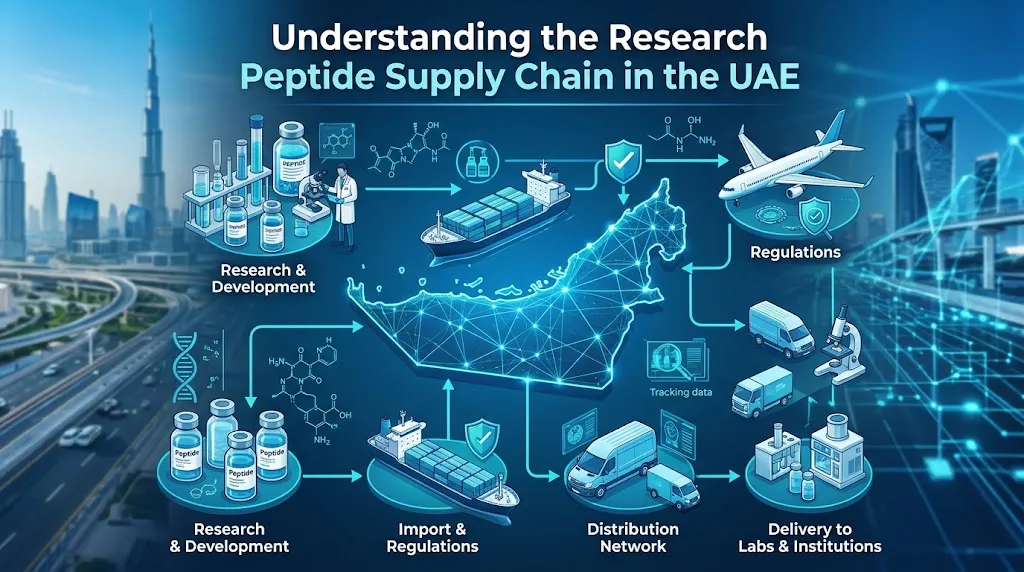
The research peptide supply chain in the United Arab Emirates (UAE) involves several stages, including manufacturing, sourcing, product identification, analytical testing, storage, transportation, and laboratory documentation.
For research organizations and laboratory professionals, understanding these stages is important when evaluating suppliers and reviewing research materials. A transparent supply chain helps establish where materials originate, how they are identified, and what supporting documentation is available.
Dubai has become an important commercial location for suppliers serving research organizations across the UAE. However, selecting a supplier requires more than comparing product availability. Laboratories should also consider batch traceability, documentation quality, testing methods, and the limitations of published analytical reports.
This guide explains the main components of the research peptide supply chain and provides a practical framework for understanding supplier documentation.
1. Understanding the Research Peptide Supply Chain
A research peptide supply chain describes the movement of research materials from their original manufacturer to the laboratory receiving them.
Depending on the product and supplier arrangement, the supply chain may involve:


- Original manufacturers.
- Distributors and research material suppliers.
- Independent analytical laboratories.
- Storage and inventory facilities.
- Packaging and transportation providers.
- Research organizations and laboratory recipients.
Each participant has a different responsibility.
Manufacturers produce and identify materials, while distributors and suppliers manage sourcing, inventory, product information, and delivery arrangements.
Independent analytical laboratories may examine selected samples and provide reports describing the tests performed and the results obtained.
Understanding these responsibilities allows researchers to distinguish between manufacturing information, supplier statements, and independently documented analytical findings.
2. Manufacturing and Product Sourcing
The first stage of the supply chain is manufacturing and sourcing.
Research materials may reach UAE suppliers through different commercial arrangements. A supplier may work directly with manufacturers or obtain products through established distribution channels.
When evaluating sourcing information, laboratories should consider:
- Whether the manufacturer or product brand is identified.
- Whether the supplier explains its sourcing arrangements.
- Whether product specifications are available.
- Whether individual products have identifiable batch information.
- Whether supporting documentation can be requested.
A supplier’s description of its sourcing process should not automatically be treated as independent verification of manufacturing quality.
Researchers should review the available records and distinguish documented information from statements that have not been independently established.
3. Batch Identification and Traceability
Batch identification is a fundamental part of research material traceability.
A batch or lot number identifies a particular production batch. It provides a reference that can connect product labels, supplier inventory records, analytical reports, and laboratory procurement documents.
For example, two products with identical names may come from different production batches.
Their associated documentation may therefore contain different testing dates, sample identifiers, and analytical findings.
Laboratories should check:
- The batch number displayed on the product label.
- The batch information recorded by the supplier.
- The sample identifier shown in the laboratory report.
- Whether the product format matches the tested sample.
- Whether any supplier-provided mapping between formats or strengths is clearly explained.
One important distinction is that a supplier may associate a published laboratory report with multiple product strengths or formats. Such an association should be identified as supplier mapping rather than direct evidence that every associated format was individually tested.
A published report also does not automatically establish the characteristics of a subsequently shipped lot.
4. The Role of Independent Laboratory Testing
Analytical testing can provide useful information about the characteristics of a research sample.
Different testing methods examine different properties, and their findings should be interpreted within the scope of the method used.
Two commonly referenced analytical techniques include:
High-Performance Liquid Chromatography (HPLC)
HPLC separates components within a sample through a chromatographic process.
Depending on the analytical method and detector configuration, the resulting chromatogram can provide information about separated components and their relative detector responses.
The interpretation of reported purity depends on the method, integration parameters, and reporting approach.
Liquid Chromatography-Mass Spectrometry (LC-MS)
LC-MS combines chromatographic separation with mass spectrometric analysis.
It can provide information about the mass characteristics of detected compounds and support analytical investigations into sample composition.
However, HPLC and LC-MS do not provide identical information. A result from one method should not automatically be presented as confirmation of every property that another method might investigate.
Researchers should examine the actual testing scope and any limitations stated in the laboratory report.
5. Understanding Certificates of Analysis
A Certificate of Analysis (COA) is an important document in research material procurement.
A COA generally provides analytical information associated with an identified product or sample.
Depending on the issuing laboratory and testing scope, a report may contain:
- Product or sample identification.
- Batch or lot number.
- Laboratory reference number.
- Testing date.
- Analytical methods.
- Reported results.
- Laboratory identification.
- Relevant testing limitations.
Not every COA contains the same information.
Some suppliers provide manufacturer-issued documentation, while others publish reports from independent analytical laboratories.
Researchers should identify the issuing organization and understand whether the document represents internal testing, manufacturer testing, or independent third-party analysis.
A COA should only be used to support conclusions that are actually covered by the reported analyses.
6. Storage and Transportation Considerations in the UAE
Storage and transportation are important stages of the research material supply chain.
The UAE’s climate makes temperature management a relevant logistical consideration for materials with documented temperature-control requirements.
Depending on the material, suppliers may use:
- Temperature-controlled storage.
- Protective packaging.
- Insulated shipping materials.
- Temperature-monitoring procedures.
- Documented delivery processes.
Laboratories should consult the manufacturer’s or supplier’s product-specific documentation for applicable storage requirements.
It is also useful to distinguish between a supplier’s general cold-chain policy and evidence that a particular shipment remained within its required temperature range throughout transportation.
Where temperature records are available, laboratories can include them in their procurement documentation.
7. Documentation at Every Supply Chain Stage
Good documentation practices help establish continuity between sourcing, inventory management, testing, and laboratory receipt.
A research organization may maintain the following records:
- Supplier name and contact information.
- Purchase and procurement references.
- Product identification and format.
- Manufacturer or brand information.
- Batch or lot identification.
- Available analytical reports.
- Storage requirements.
- Delivery and receipt records.
- Any documented discrepancies.
These records help laboratories identify the materials they received and connect them with the supporting information supplied during procurement.
Maintaining organized documentation can also make internal reviews and future material verification more straightforward.
8. Evaluating Research Peptide Suppliers in Dubai and the UAE
When comparing research peptide suppliers in Dubai and other UAE locations, laboratories should consider several practical factors.
Sourcing Transparency
Can the supplier identify the product brand and explain its sourcing arrangements?
Batch Traceability
Can the supplied material be connected to a specific batch identifier?
Documentation Availability
Are product specifications and relevant analytical reports accessible?
Testing Transparency
Does the supplier distinguish between internal testing, manufacturer documentation, and independent laboratory testing?
Storage Information
Are product-specific storage requirements clearly documented?
Communication
Can the supplier explain the scope and limitations of its available documentation?
These considerations provide a more meaningful assessment than product descriptions or general quality statements alone.
9. Remy Research and Supply Chain Documentation
Remy Research is a Dubai-based research peptide supplier serving customers across the UAE.
Its official website provides information about its research-use-only catalogue, sourcing arrangements, product formats, and published laboratory documentation.
The company identifies several product brands within its catalogue and provides access to selected analytical reports associated with named samples and batches.
These reports should be interpreted individually. A laboratory report establishes findings for the sample identified in that report. Where a supplier maps a tested sample to other strengths or formats, that association should not be confused with direct testing of every associated product.
Similarly, published results should not be assumed to represent the current shipping lot unless the batch identification establishes that connection.
Researchers can explore the company’s available product and documentation information through the official Remy Research website.
For additional information about identified samples and their published analytical records, laboratories can consult the company’s published batch reports.
Conclusion
Understanding the research peptide supply chain in the UAE requires attention to sourcing, manufacturing information, batch identification, analytical testing, documentation, storage, and transportation.
For laboratories, the most important objective is maintaining a clear connection between the physical research material and its supporting records.
By examining supplier information, reviewing batch identifiers, understanding analytical methods, and recognizing the limitations of published reports, research organizations can make more informed procurement decisions.
A transparent supply chain is not simply about making documents available. It is about ensuring that the available information is identifiable, appropriately scoped, and traceable to the material being reviewed.
Research Use Only: Materials discussed in this article are intended strictly for in-vitro laboratory research only. They are not intended for human or veterinary use. Nothing in this article constitutes medical advice, diagnosis, treatment, or a recommendation for human or veterinary application.


