
Introduction
The construction industry in the UAE and across the Persian Gulf is experiencing rapid growth. Megacities like Dubai are expanding at an extraordinary pace, but such rapid development also brings serious challenges. Many contracting companies face familiar problems: inflated budgets due to untracked expenses, uncoordinated material delivery schedules, and chaos in subcontractor management. In such conditions, survival in the market directly depends on a company’s ability to control every dirham and every stage of work. Digitalisation is no longer optional; it is a strict necessity.
In this article, prepared by experts from First Bit, we will explore how modern ERP solutions help bring order to the construction business.
Why Construction Businesses Lose Money: Key Inefficiency Points
Managing construction always means managing a complex system involving many participants. Traditional accounting methods often lead to “black holes” in project budgets. The most problematic areas include untracked material leftovers (for example, cement or reinforcement may simply “disappear” at a construction site), costly equipment downtime, and even theft.
Human factors also play a role. Site managers may adjust data retroactively in Excel spreadsheets to hide overspending, while accounting departments receive information about material write-offs weeks later.
Another common trap is “patchwork automation.” Warehouses track inventory in one system, accounting manages payroll in another, and site supervisors work with paper documents. The lack of integration creates chaos. As a result, business owners see only general figures and cannot quickly intervene when one project is already overspending while equipment at another site remains idle for days.
ERP as a Single Source of Truth for Developers
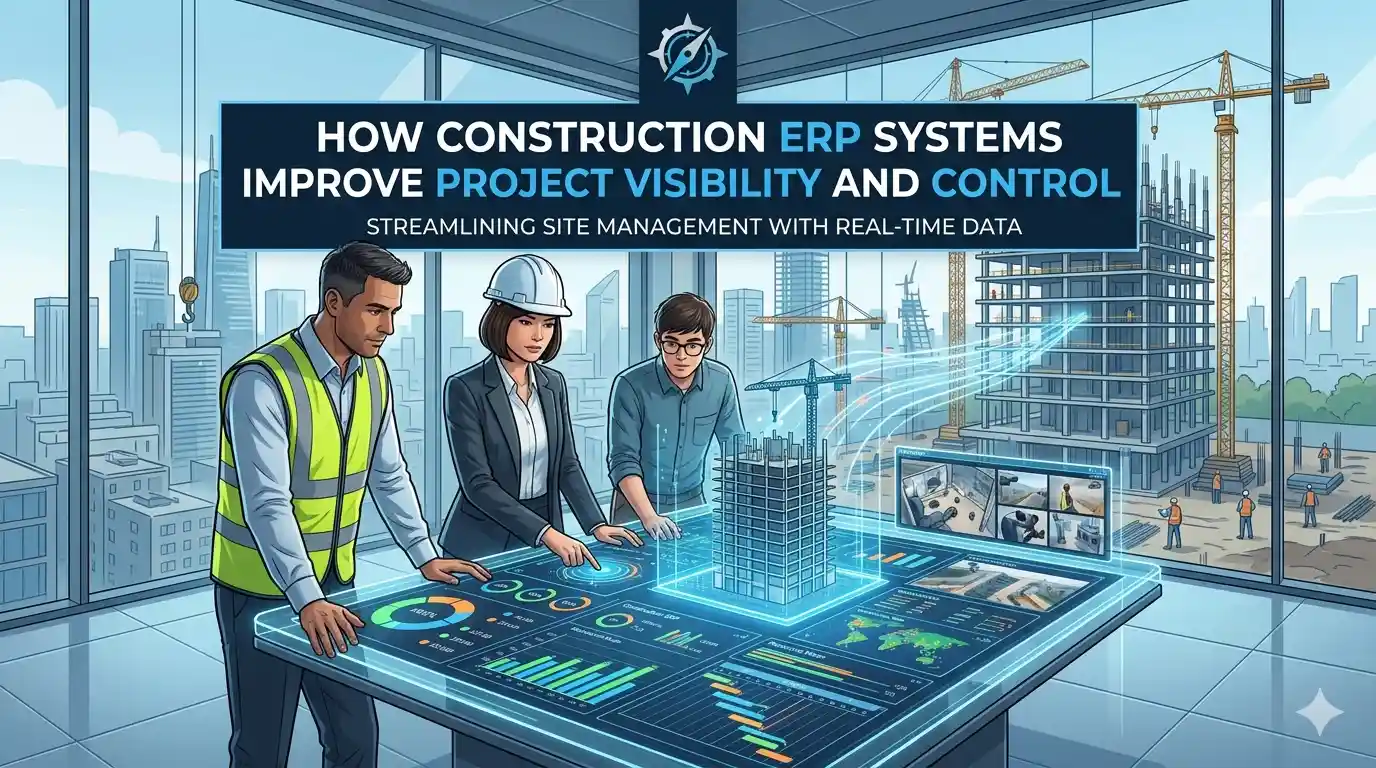
The solution to fragmented data is the implementation of an ERP system. This is not just software for accountants; it is a unified information environment that connects the office and remote construction sites in real time.
The concept of a Single Source of Truth means that all data from the arrival of a bag of cement at the warehouse to the signing of a completed work certificate is recorded in one system.
Such centralisation eliminates opportunities for manipulation. If a site manager records material usage through a mobile application directly at the construction site, the office sees the same data instantly. It becomes impossible to delete or retroactively modify records without leaving a digital trace.
For developers, this means regaining control over operations. Reporting becomes transparent, and the responsibility of each team member becomes clearly defined. Using ERP for construction finally allows companies to see the real situation at their sites.
Cost Transparency: From Foundation to Project Completion
One of the biggest concerns for any developer is cost control. Without automation, it is difficult to understand why the estimated project cost suddenly diverges from actual spending.
Modern ERP software enables real-time project cost management. The system automatically compares planned indicators with actual expenses on materials, labour, and subcontractor services.
If a purchase is made above the estimated price or if material consumption exceeds the standard, responsible managers and executives immediately receive alerts. This makes it possible not only to record losses after the fact but to manage the situation in real time.
Financial transparency also helps predict cash flow gaps more accurately. Executives can see how much money will be needed next week to settle payments with suppliers and can redistribute financial flows within the company in advance. Such detailed financial management makes projects profitable and businesses more resilient.
Digital Construction Site Control: Managing Resources Online
A construction site is where physical assets are transformed into real estate, but it is also where most losses occur. Implementing ERP moves control directly to the construction site.
Material deliveries and consumption are now tracked online. When a warehouse manager or site supervisor receives materials, they record them immediately in the system, and when materials are used, they are written off against specific stages of work.
Mechanics can link transport documents to specific sites, making it easy to separate operations across different locations.
The system also tracks workforce productivity and working hours by project. Timesheets are no longer paper documents that can be manipulated, but digital records connected to specific construction tasks.
Equipment monitoring also reaches a new level. Sensors installed on heavy machinery can integrate with the ERP system, automatically recording machine hours, mileage, and most importantly, downtime. This allows companies to quickly reallocate equipment between sites and avoid costly idle periods.
Such detailed monitoring makes construction operations truly transparent, with ERP acting as the central control tool.
Managing Subcontractors and Contracts within ERP
Construction companies rarely complete all work on their own. Subcontractors are a standard part of the industry, but they also represent a major risk area. Without automation, it is easy to lose control over the volume of completed work and payment schedules.
In an ERP system, contract management becomes systematic. All agreements, work stages, and financing schedules are recorded in the system, making settlements with subcontractors completely transparent.
You no longer have to guess whether you paid concrete contractors for the exact volume they poured last week. The system automatically compares work completion certificates with contract terms. Accountants and technical supervisors no longer need to manually reconcile documents; everything is already synchronised within a single record.
This ensures legal accuracy in documentation and eliminates risks such as duplicate payments or missed penalties for subcontractor delays. A comprehensive ERP approach helps construction companies build transparent and mutually beneficial relationships with partners.
Why Choosing the Right Implementation Partner Matters in the UAE
The UAE market has unique characteristics. International reporting standards are widely used, multi-currency accounting is common, and local regulatory requirements for documentation may differ from those in other countries.
Simply purchasing a foreign software solution and installing it in a Dubai office is not enough. For the system to function properly and remain compliant with regulations, deep localisation and customisation are required.
This is why choosing the right implementation partner is critical. The integrator should not just offer a boxed solution but a flexible system adapted to local taxation, currency control, and business practices.
Only companies with experience in the local market can build a truly effective solution for businesses operating in the UAE.
First Bit — Expert Construction Automation in the UAE
First Bit is exactly such a partner. The company specialises in management and accounting automation and offers powerful ERP solutions designed specifically for construction companies and contractors in Dubai and across the region.
The team’s deep expertise allows them to configure systems according to real business needs while ensuring full compliance with local regulations and industry practices.
Conclusion
The construction market in the UAE leaves little room for error. In an environment of strong competition and high quality standards, success belongs to companies that can accurately track the cost of every stage of work and the use of every resource.
Implementing an ERP system is not simply purchasing software; it is a strategic investment in the transparency, control, and scalability of your business. It is a tool that can save millions by preventing theft, downtime, and inefficient resource use.
To take the first step toward full transparency in your projects, visit the First Bit website and request a consultation or product demonstration tailored specifically to the construction industry in the UAE.